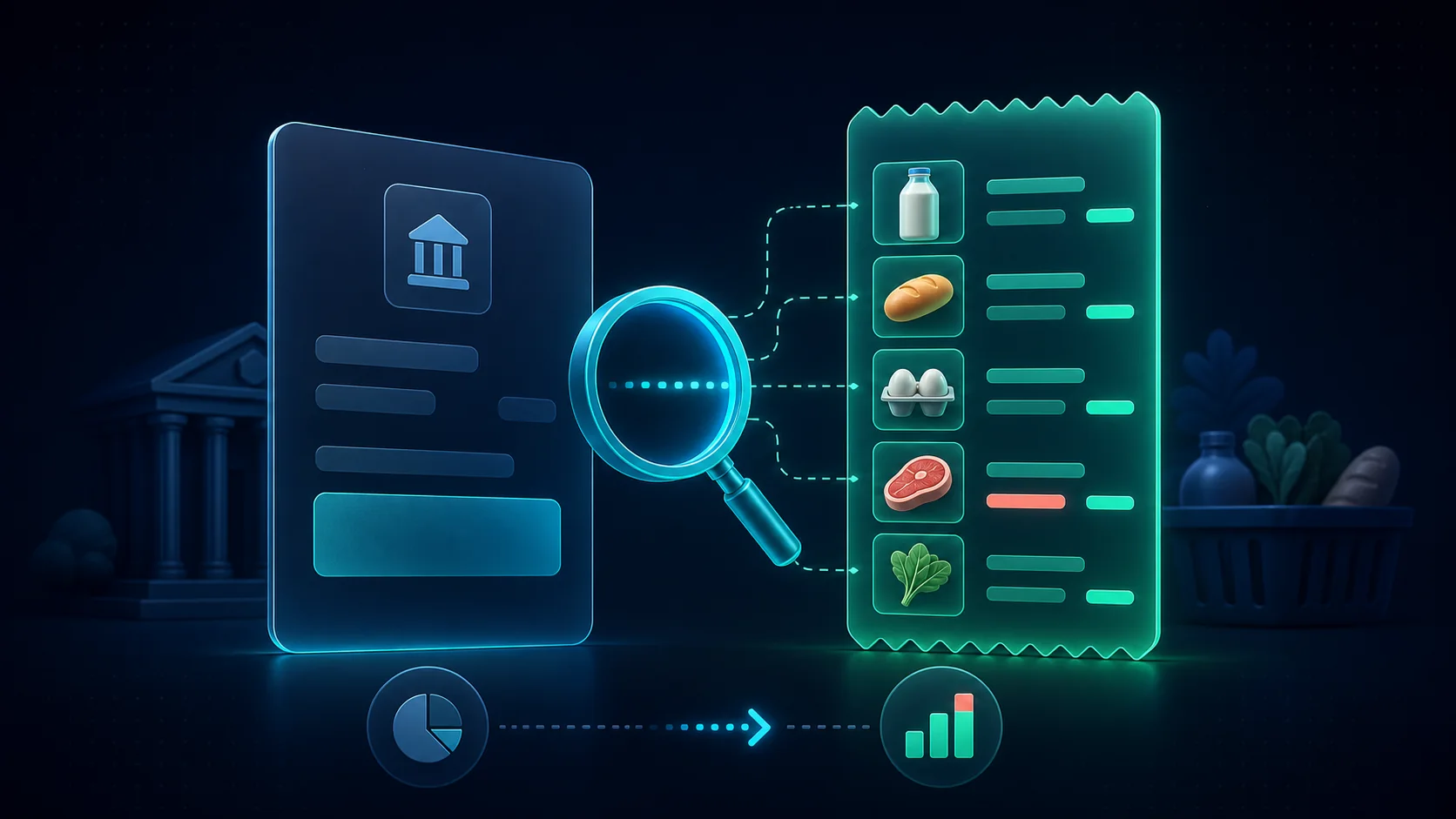
A bank statement can tell you when money left an account, which merchant was named, and how much was charged. It usually cannot tell you which products, package sizes, discounts, or substitutions produced that total. That missing detail matters when you are asking whether a particular product became more expensive.
Use the transaction as a cash-flow record and the receipt as the product record. Keep both, label what each can support, and use CPI or HICP for a broader statistical reference rather than treating one household’s basket as an official index.
Start with the question you need to answer
“Did our grocery spending rise?” needs totals over time. “Did the same oats cost more?” needs a normalized product line. “Is food inflation easing nationally?” needs an official price program. One record cannot answer all three questions.
Compare the fields in each record
| Field | Bank transaction | Itemised receipt | Use |
|---|---|---|---|
| Date and merchant | Usually present | Usually present | Match the purchase |
| Total paid | Present | Present | Cash-flow reconciliation |
| Product and quantity | Usually absent | Usually present | Compare like with like |
| Pack size and unit | Absent | Often present | Calculate unit price |
| Discount and substitution | Often absent | May be present | Explain a change |
Work through the same-total example
Purchase A and B both total €48 at the same store. The first receipt has four 1 kg rice bags at €3 each and ten other items. The second has two 1 kg bags at €4.50 and twelve other items. The bank record shows two €48 charges; it cannot tell you that rice quantity and unit price changed.
The same total is not evidence that prices were stable. It may reflect a smaller quantity, a substitution, a discount, or a different basket.
Use a three-layer comparison
- Reconcile cash flow. Match the bank total to the receipt total and date.
- Normalize items. Keep product, quantity, package, unit price, discount, and substitution fields.
- Choose the right benchmark. Use your repeat-purchase history for your household and CPI/HICP for the wider economy.
Do not fill missing fields with confidence
A merchant descriptor may be shortened, delayed, or shared by several store locations. Open-banking providers also differ in the fields they expose. Say “not available in this record” instead of guessing an item category or price.
Personal inflation is a different measure
The U.S. Bureau of Labor Statistics publishes average prices for selected items, while Eurostat documents the HICP methodology. These programs use defined samples and methods. Your repeat-purchase history reflects your recipes, stores, quantities, timing, and substitutions.
What this method cannot prove
Two receipts cannot establish a national trend, a cause of inflation, or a permanent price. Missing receipts, stock-outs, quality changes, and pack-size changes limit the comparison.
- Do not infer item prices from a merchant total.
- Do not treat a bank category as a product identity.
- Do not present a personal basket as CPI or HICP.
Choose the right data source
Use your bank statement or banking app for monthly reconciliation, receipts for repeat-product prices, a spreadsheet for an audit trail, and official statistics for macro context. Combining layers is more honest than asking one source to do every job.
How Lumy can help organise the layers
Lumy does not connect to your bank. It works from the receipt side: the receipt scanner reads the merchant, date, total and each product line, including discount and deposit lines, from a photo of a paper receipt or a screenshot of an e-receipt. The purchase is saved straight away, and you can open it afterwards to correct anything the scan misread. With Pro, each product on a scanned receipt adds to a price history built from your own receipts, and Opportunities shows overpayments and spending increases measured against your household’s own history. Those prices are what you paid on the receipts you scanned, not current shop prices. On the free plan, the AI assistant gets 10 requests a month, and each receipt photo uses one, just as a typed or voice message does; Pro removes that limit and scans up to 5 receipts at once.
Your next step: pair five receipts with transactions
Choose five recent grocery purchases. Match each bank total to its receipt, mark the fields missing from the transaction, and calculate a unit price for three repeat products. The missing-field list is the answer to what your data can and cannot say.
Sources and methodology
The worked example is illustrative. Official price statistics and household transaction histories use different definitions and should not be merged into one number.
Prepared and reviewed: 31 July 2026.